
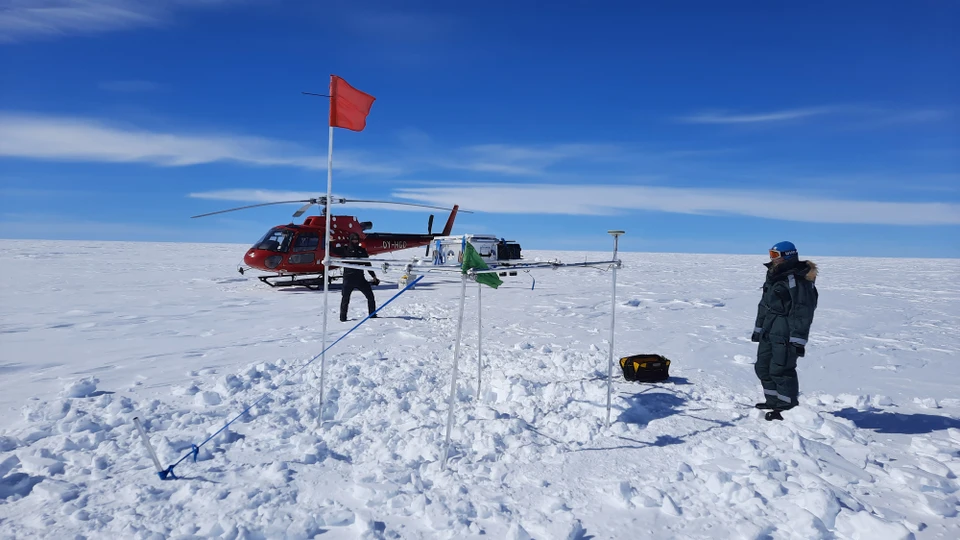
Researchers have recorded the velocity (movement) of ice far from the coast in an area at the glacier Sermeq Kujalleq in West Greenland. The measurements show that the ice over 100 km inland from the edge of the ice has increased its velocity by between 5 and 15% since previous measurements in 1959.
The study is published in Communications Earth and Environment.
15% may not sound like much, but the locations of the measurements mean that the study’s results make us rethink our understanding of the ice. Until now, we have believed that the ice masses along the edge of the Greenland Ice Sheet and by the large glaciers are racing cars, while we expect to find more speed bumps the further into the Greenland Ice Sheet we get – but that may not be true at all.
“We know that Sermeq Kujalleq moves at an extremely high speed, and we generally know a lot about movement and acceleration along the edge of the ice, because we have been able to document it. We assumed that the ice in the ice sheet interior would be reacting more slowly, but the new measurements show that this is not the case in that area,” says Anja Løkkegaard, who is a postdoc at GEUS and first author of the research article in which the study is presented.
It is a logistically challenging area to make measurements in, but the GPS measurements can do something that the satellite measurements cannot:
“It is very difficult to operate this far into the ice sheet, but it is important to measure the ice velocities in there via GPS, as the satellite-derived data become less reliable further inland from the coast. With the GPS observations measured far into the Greenland Ice Sheet, we can now see an acceleration of the ice sheet, which the satellites cannot yet register,” says co-author Shfaqat Abbas Khan, who is a professor at DTU Space and has processed the GPS data.


