On 17th of June in 2017, a rock avalanche in Karrat Fjord, Northwest Greenland, generated displacement waves with a runup of 10 m. Four lives were lost and the settlement Nuugaatsiaq (30 km away) was evacuated and permanently abandoned. Rock slope failures on the Greenland coast are not unusual. Vaigat (150 km south, Fig. 1 below) has experienced at least two large tsunamis in the last 70 years. In addition to the life-threat, landslides drastically change the seafloor morphology conditioning the ecosystem evolution, with subsequent implications for the local economy. However, the long-term history, frequency, and control factors of the landslides in Northwest Greenland are not fully understood which hampers the ability to identify high-risk locations.
Project: Landslides in a changing climate
- Geohazards and benthic habitats in Northwest Greenland
The study
A direct link between the current trend towards warm climate and decreasing slope stability has recently been suggested based on an increasing incidence of landslides in polar marginse. In addition to the common triggers of landslides, increased precipitation, permafrost degradation and rapid isostatic rebound become determining preconditioning factors for slope instability in polar margins. However, the climate link to the landslide occurrence remains to be evaluated in examples from the geological past.
The detailed study of the mass transport deposits in Karrat Fjord and Vaigat has the potential to reveal the frequency and magnitude of landslides (or rock avalanches) and tsunamis in West Greenland, their relation to climate change and the variability of the Greenland ice sheet, and their impact on benthic habitats. Thus, we propose to utilize the nearshore landslide record in West Greenland, and published climate studies, to bridge knowledge gaps on climate-related triggers for slope instability, and the implications of the current trend of climate change.
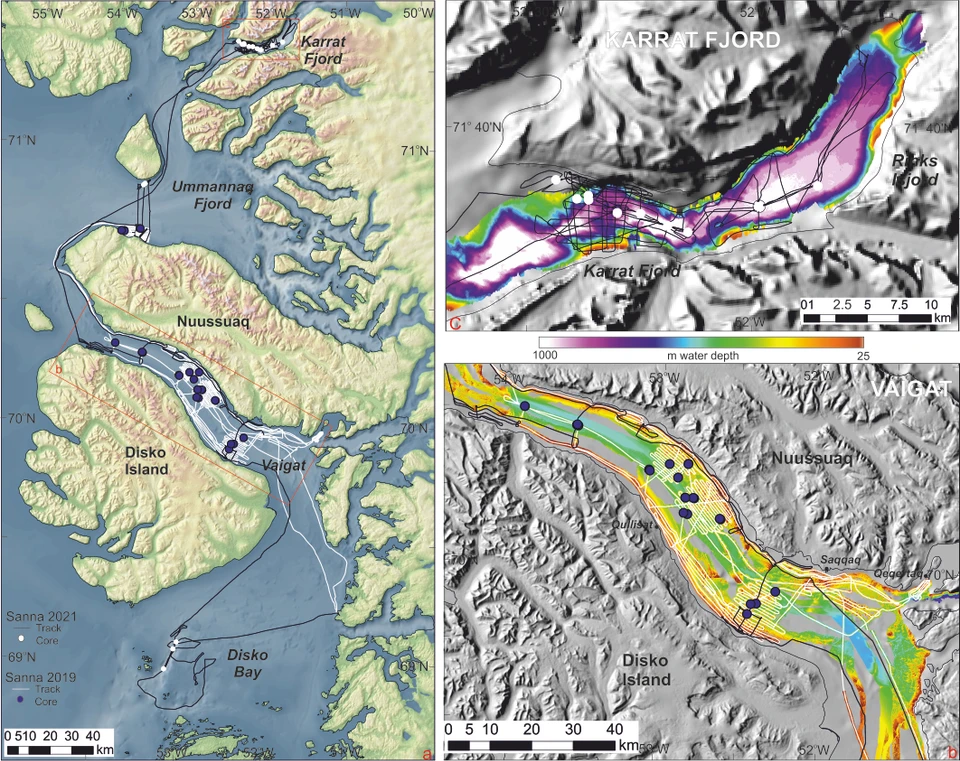
Study area and data
Methods
Expeditions onboard RV Sanna in 2019 and 2021 collected ~4000 km of seismic, sub-bottom and swath bathymetry data within Karrat Fjord and Vaigat, with particular focus on areas of offshore exposed slope failures. Swath bathymetry data from Merian 2017, OMG 2015 and JCR175, and LAKO transits have been made available for this project in collaboration with national and international partners. In addition, 29 gravity cores of up to 6 m were recovered during Sanna’s expeditions.
Morpho-structural and seismic-stratigraphic analyses of the geophysical data from Karrat Fjord and Vaigat will reveal the geological history of landslide occurrences. Seafloor geomorphology will be analysed to evaluate the most recent sedimentary processes and the spatial distribution of benthic habitats.
The project objectives are within the scope of Geocenter Denmark by investigating climate change and geohazards to maintain a resilient society. They also contribute to the United Nations (UN) Sustainable Development Goals [13: Climate; 11: Sustainable communities; 14: life in the ocean].

RV Sanna - photo taken by Cecilia Vanman
Project partners


International collaborators


MagellanPlus Workshop 21-23 November 2022
Lara F. Perez
Senior Researcher
Near Surface Land and Marine Geology
Kick-off workshop the 2th of june 2022
On the 2th of june 2022 there will be a kick-off workshop with information about the project. Read the flyer and check the schedule for interesting presentations.
Articles about the project
Project period
The project lasts for 2 years from 1 June 2022.

Seismic adquisition - photo taken by Lara F. Perez
Project participants
GEUS
Marine Geology:
Lara F. Pérez
Paul C. Knutz
Verner B. Ernstsen
Mineral resources:
Kristian Svennevig
Geophysics & Sedimentary Basins:
Tove Nielsen
Kenneth Bredensen
Glaciology:
Camilla S. Andresen
Aarhus University – Department of Geoscience
Katrine J. Andresen
Christof Pearce
Marit-Solveig Seidenkrantz
Egon Nørmark
University of Copenhagen – Dep. Geosciences & Natural Resource Management
Thorbjørn J. Andersen
Mikkel Fruergaard
Aart Kroon
University of Copenhagen – GLOBE
Nicolaj K. Larsen
International collaborators
Greenland Nature Institute
Diana Krawczyk
Aqqaluk Sørensen
Karl Zinglersen
Marine Space
Mathew Owen
British Antarctic Survey
Kelly Hogan