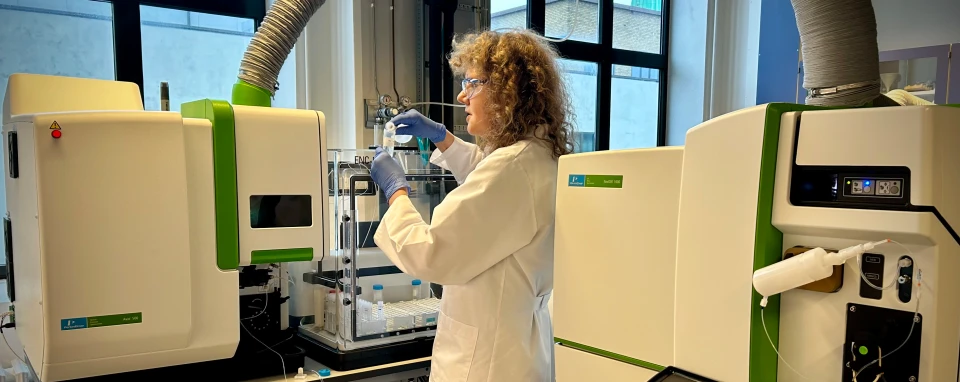
Analyses performed at the facility
The laboratory offers quantitative and semi-quantitative analyses. Custom methods including additional analytical requirements can be setup and performed on request. We are always open to discuss how to assist and to develop new or improve on our analytical approaches. The list of methods below is carried out on a routine basis.
- Full package: Highly accurate determination of the abundance of 46 major, minor and trace elements by combined ICP-OES and ICP-MS analysis. This method is often the preferred approach for many rock, soil, and mineral samples. Major elements: Al, Ca, K, Na, Mg, Mn, Fe, P, Ti (usually measured by ICP-OES (Si under development)). Trace elements: Li, Sc, V, Cr, Co, Ni, Cu, Zn, Ga, Rb, Sr, Y, Zr, Nb, Mo, Cs, Ba, La, Ce, Pr, Nd, Sm, Eu, Gd, Tb, Dy, Ho, Er, Tm, Yb, Lu, Hf, Ta, Pb, Th, U (usually measured by ICP-MS).
- Quantitative trace element analysis is a robust ICP-MS quantification method to acquire highly precise and accurate elemental concentrations of usually the 41 elements; Li, Mg, Al, Ca, Sc, Ti, V, Cr, Mn, Fe, Co, Ni, Cu, Zn, Ga, Rb, Sr, Y, Zr, Nb, Cs, Ba, La, Ce, Pr, Nd, Sm, Eu, Gd, Tb, Dy, Ho, Er, Tm, Yb, Lu, Hf, Ta, Pb, Th, U. It is often used on rock, soil or mineral samples where only trace elements are required, e.g. where major element abundances were already measured.
- Arsenic (As) analysis is a special quantitative ICP-OES method used on water samples for environmental purposes. It includes the elements Ca, Al, Si, P, Fe, Mg, Mn, Mg, Cu and As.
- TotalQuant: Semi-quantitative method including the 71 elements; Ag, Al, As, Au, B, Ba, Be, Bi, Ca, Cd, Ce, Cl, Co, Cr, Cs, Cu, Dy, Er, Eu, Fe, Ga, Gd, Ge, Hf, Hg, Ho, In, Ir, K, La, Li, Lu, Mg, Mn, Mo, Na, Nb, Nd, Ni, Os, P, Pb, Pd, Pr, Pt, Rb, Re, Rh, Ru, S, Sb, Sc, Se, Sm, Sn, Sr, Ta, Tb, Te, Th, Ti, Tl, Tm, U, V, W, Y, Yb, Zn, Zr. It is typically used for screening purposes, e.g. to 'fingerprint' the chemistry of samples prior to a more robust element quantification and is regularly used on water samples.
Sample Preparation Laboratory
Normally the solution analyses require 5 to 10 ml of sample material. For solid samples, usually 5-10 grams of fine grained (i.e. with a homogenised grain size of < 100 µm) material is sufficient. We do not have special demands regarding the packaging used for the storage of the materials to be analysed other than they do not leak or can be contaminated.
Together with our well-equipped Sample Preparation Laboratory we are usually able to take care of any necessary sample preparation step from the raw material state to an analytically ready product. If required, we can perform all the material defragmentation and fine crushing, grinding, dissolution and digestion, or any other kind of sample preparation prior to the solution of the material and the ICP analysis.
Quality control (QA/QC) of the analyses
Performance tests are one of the most efficient ways for an analytical laboratory to monitor the quality of the analyses being performed. Since the installation of our first ICP-MS in 1999, the laboratory has participated in IAG's proficiency test program (GeoPT), where we continuously produce robust accurate and precise results. Approximately 110 analytical laboratories from around the world contribute to this proficiency test program. The biannual performance tests of the GeoPT program are designed to be an external quality control performed on a regular basis for the analysis of a wide range of natural geological materials.